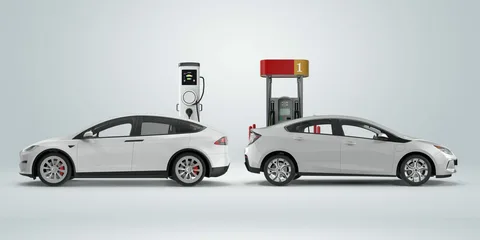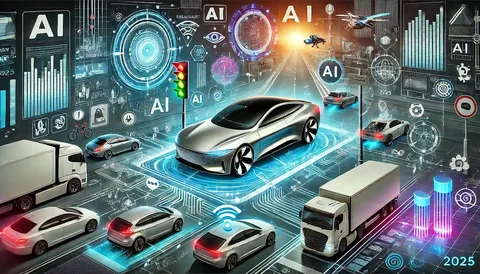
Artificial intelligence is transforming the automobile industry at a remarkable pace.
For more than a century, automotive innovation focused heavily on engines, transmissions, materials, and mechanical engineering. Today, software and artificial intelligence are becoming equally important.
AI is being used in vehicle manufacturing, driver-assistance systems, navigation, predictive maintenance, electric vehicles, customer service, and autonomous-driving research.
The result is a gradual shift toward vehicles that can understand their surroundings, learn from data, communicate with drivers, and make certain decisions automatically.
What Is AI Doing in Cars?
Artificial intelligence allows vehicles to process information and identify patterns.
Modern vehicles can collect information from cameras, radar, ultrasonic sensors, GPS systems, and other components.
AI software can then analyze this information to help the vehicle understand its surroundings.
For example, a car may identify:
- Other vehicles
- Pedestrians
- Traffic signs
- Road markings
- Obstacles
- Traffic conditions
- Parking spaces
This information can support safety and convenience features.
AI-Powered Driver Assistance
One of the most visible uses of AI is advanced driver assistance.
Modern vehicles can offer features such as:
- Automatic emergency braking
- Lane departure warnings
- Adaptive cruise control
- Blind-spot monitoring
- Traffic-sign recognition
- Parking assistance
- Driver monitoring
These systems are designed to assist drivers rather than eliminate the need for human attention.
Drivers should always understand the limitations of their vehicle’s assistance systems.
Self-Driving Technology
Autonomous driving is one of the most discussed applications of AI in automobiles.
Self-driving technology uses cameras, radar, sensors, maps, and software to understand the road and make driving decisions.
However, autonomous driving exists at different levels.
Some systems provide relatively limited assistance, while others can perform more driving tasks under specific conditions.
Fully autonomous vehicles capable of handling every road situation without human supervision remain a much more difficult engineering challenge.
AI and Electric Vehicles
Artificial intelligence is particularly useful for electric vehicles.
EVs contain sophisticated battery-management systems that monitor battery temperature, charging, energy usage, and performance.
AI can help optimize energy consumption and predict how much range may remain.
This can help drivers make better decisions about charging and route planning.
Predictive Maintenance
Traditional vehicle maintenance often follows a fixed schedule.
AI can potentially make maintenance more predictive.
A vehicle can monitor sensors and identify unusual behavior before a component fails.
For example, software could detect changes in temperature, vibration, battery performance, or other measurements.
Instead of waiting for a problem to become obvious, a vehicle could potentially alert the owner that inspection may be necessary.
This could reduce unexpected breakdowns.
AI-Powered Navigation
Navigation systems have also become smarter.
AI can analyze traffic patterns and other information to recommend routes.
Instead of simply selecting the shortest physical route, an intelligent navigation system can consider congestion and changing road conditions.
In the future, vehicles may increasingly combine navigation data with real-time vehicle information to optimize energy consumption and arrival times.
AI in Vehicle Manufacturing
AI is not only changing the cars themselves.
Manufacturers are also using artificial intelligence in factories.
AI-powered systems can inspect components, identify manufacturing defects, predict equipment failures, and optimize production processes.
Computer vision systems can examine parts faster and more consistently than traditional manual inspection in certain applications.
Robotic systems can also work alongside human employees to perform repetitive manufacturing tasks.
AI and Car Design
Artificial intelligence can assist automotive engineers during the design process.
Engineers can use computational tools to test different shapes, materials, structures, and aerodynamic configurations.
AI can analyze large numbers of potential designs and identify promising solutions.
This can reduce the amount of time required to explore certain engineering possibilities.
AI-Powered Voice Assistants
Voice control is becoming increasingly common in modern vehicles.
Drivers can use voice commands to control navigation, make calls, adjust certain settings, select music, or access information.
AI-based voice systems are becoming better at understanding natural language.
Instead of memorizing exact commands, drivers may increasingly be able to speak to their vehicles more naturally.
Personalized Vehicle Experiences
AI can also personalize the driving experience.
A vehicle could potentially learn a driver’s preferences for:
- Seat position
- Climate settings
- Navigation
- Music
- Driving modes
- Frequently visited destinations
Different drivers can then receive customized settings when they use the same vehicle.
AI and Vehicle Safety
Safety may be one of the most important benefits of automotive AI.
Human drivers can become distracted, tired, or overwhelmed.
AI systems do not experience fatigue in the same way humans do.
Driver-monitoring systems can watch for signs of distraction or reduced attention and issue warnings when appropriate.
External sensors can also help identify hazards that a driver might not notice immediately.
However, AI systems can also make mistakes, which is why human supervision remains important for many current systems.
AI and Cybersecurity
As vehicles become more connected, cybersecurity becomes increasingly important.
Modern cars can communicate with smartphones, cloud services, navigation systems, charging networks, and other devices.
This creates additional opportunities for useful features but also increases the number of systems that need protection.
Automakers therefore need strong cybersecurity practices to protect vehicle software and user data.
AI and Car Insurance
Artificial intelligence could also influence insurance.
Connected vehicles can collect information about driving behavior, vehicle usage, and accidents.
Insurers may use data to better understand risk.
However, this raises questions about privacy, data ownership, transparency, and how driving information is used.
Consumers will need to understand what information their vehicles collect and how that data is shared.
AI in Used-Car Buying
AI is also beginning to influence the way people shop for vehicles.
Online platforms can use algorithms to recommend cars based on budget, preferences, location, and previous searches.
AI can also help analyze vehicle listings and organize information about features and pricing.
However, buyers should still inspect vehicles physically and verify important information before purchasing.
Challenges of AI in Cars
Artificial intelligence offers major opportunities, but it also introduces challenges.
Reliability
AI systems must work correctly in difficult weather, unusual road conditions, and unexpected situations.
Privacy
Connected vehicles can collect large amounts of information.
Cybersecurity
More connected systems create additional potential attack surfaces.
Cost
Advanced sensors and computing systems can increase vehicle prices.
Regulation
Governments must establish appropriate rules for increasingly automated vehicles.
Will AI Replace Human Drivers?
It is unlikely that human driving will disappear everywhere at the same time.
Different countries have different roads, regulations, infrastructure, weather conditions, and technological adoption rates.
For the foreseeable future, many drivers will use vehicles that combine human control with AI assistance.
Fully autonomous transportation may eventually become more widespread in carefully controlled environments, but widespread autonomy across every road remains a complex challenge.
The Future of AI in Automobiles
The automotive industry is moving toward a future where cars are increasingly software-defined.
Future vehicles may receive software updates, learn driver preferences, optimize energy usage, communicate with infrastructure, and provide increasingly sophisticated assistance.
Electric vehicles are likely to accelerate this transition because their powertrains are already heavily controlled by software.
The vehicle of the future may therefore be less like a traditional mechanical machine and more like a connected computing platform that happens to move.
Final Thoughts
Artificial intelligence is changing almost every stage of the automobile industry.
It is helping manufacturers improve production, assisting engineers with vehicle design, supporting drivers with safety systems, improving navigation, monitoring vehicle health, and optimizing electric-vehicle performance.
Self-driving technology remains one of the most ambitious applications, but AI is already delivering practical benefits through driver assistance and vehicle intelligence.
At the same time, challenges involving safety, privacy, cybersecurity, cost, and regulation must be addressed.
As AI technology continues to improve, cars will likely become more connected, more intelligent, and increasingly capable of assisting drivers.
The automotive industry is no longer just about horsepower and mechanical engineering. In 2026 and beyond, software, data, and artificial intelligence are becoming central parts of the driving experience.