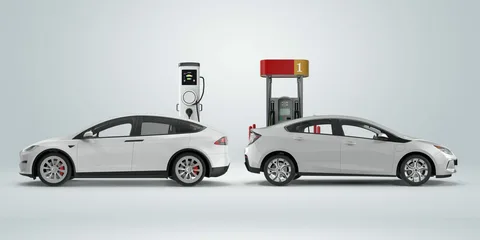
The choice between electric cars and petrol cars has become more complicated in 2026. Electric vehicles have continued to improve, while petrol-powered cars remain popular because of their established infrastructure, familiar driving experience, and convenience for long-distance travel.
For someone buying a car today, the decision is no longer simply about choosing the newest technology. Factors such as purchase price, fuel or electricity costs, charging availability, maintenance, driving range, performance, and local infrastructure all matter.
So, which is better in 2026: an electric car or a petrol car?
The answer depends largely on how and where you drive.
What Is an Electric Car?
An electric vehicle, commonly called an EV, uses one or more electric motors powered by a rechargeable battery.
Unlike a conventional petrol car, an EV does not need a traditional internal-combustion engine to move the vehicle.
Electric cars are charged using electricity. Depending on the vehicle and charger, charging can take anywhere from a relatively short period to several hours.
Many EVs also use regenerative braking, which allows some energy normally lost during braking to be recovered and sent back to the battery.
What Is a Petrol Car?
A petrol car uses an internal-combustion engine. Petrol is mixed with air and burned inside the engine to create the energy required to move the vehicle.
Petrol-powered vehicles have been around for more than a century, which means there is an extensive infrastructure supporting them.
Fuel stations are widely available in many countries, and mechanics are generally familiar with repairing conventional engines.
Purchase Price
One of the first things buyers consider is the initial purchase price.
Electric cars can be more expensive than comparable petrol vehicles in some markets, although the price gap varies considerably by model and country.
Battery technology has improved and EV manufacturers have introduced models across more price categories.
Petrol cars, meanwhile, remain available at many different price points.
For buyers with a limited budget, petrol vehicles can therefore still offer a wider selection depending on the local market.
However, purchase price is only one part of the overall cost of owning a car.
Fuel Costs vs Charging Costs
One major advantage of an electric vehicle can be its energy cost.
Electricity can be cheaper per kilometer than petrol, particularly for owners who can charge at home and have access to favorable electricity rates.
The actual savings depend on electricity prices, petrol prices, vehicle efficiency, and driving habits.
Public charging can also be more expensive than home charging, so EV owners should consider where most of their charging will take place.
Petrol cars offer a simpler system. You visit a fuel station, fill the tank, and continue driving.
Maintenance Costs
Electric cars generally have fewer moving parts in their powertrains than petrol vehicles.
They do not require traditional engine oil changes, and they lack many components associated with conventional engines.
This can reduce some routine maintenance requirements.
Petrol cars require regular maintenance such as oil changes, engine servicing, filter replacement, and other mechanical inspections.
However, EVs still require maintenance. Tires, brakes, suspension components, cooling systems, electronics, and other parts can require inspection or replacement.
Driving Range
Range is one of the biggest considerations for EV buyers.
Modern electric cars can travel significantly farther on a single charge than many earlier EVs could. However, the actual range varies according to battery size, vehicle efficiency, speed, weather, terrain, and driving style.
Petrol cars generally offer a familiar advantage for long-distance travel. A driver can refuel at a petrol station in a few minutes and continue the journey.
This can make petrol cars particularly convenient in areas where charging infrastructure is limited.
Charging Infrastructure
Charging availability is one of the most important factors when considering an electric car.
Drivers who have a home charger may find EV ownership extremely convenient. They can often charge the vehicle while sleeping or while the car is parked at home.
People who live in apartments or areas without convenient charging may have a more difficult experience.
Public charging networks are expanding in many parts of the world, but availability and reliability can vary greatly from one location to another.
Petrol vehicles have a major advantage here because fuel stations are already widespread in many regions.
Performance
Electric vehicles are known for their immediate torque.
When the accelerator is pressed, an electric motor can deliver strong acceleration almost instantly.
This can make EVs feel very responsive, especially from a standstill.
Petrol cars can also offer impressive performance, particularly vehicles equipped with turbocharged or high-performance engines.
However, the driving experience is different.
EVs tend to be quiet and smooth, while petrol vehicles provide engine sounds and gear changes that some drivers enjoy.
Environmental Impact
Environmental impact is another important part of the comparison.
Electric cars produce no tailpipe emissions while driving. This can help reduce local air pollution, particularly in cities.
However, EVs are not completely impact-free.
Battery production requires raw materials and energy, while electricity generation can produce emissions depending on how the electricity is produced.
Petrol cars directly produce exhaust emissions when fuel is burned.
The overall environmental impact of either vehicle depends on factors including manufacturing, energy sources, vehicle efficiency, driving distance, and how the vehicle is eventually recycled.
Battery Life
Battery technology is a major concern for potential EV buyers.
Modern electric vehicle batteries are designed to last for many years, but their capacity can gradually decrease over time.
Manufacturers typically provide battery warranties with specific conditions and mileage limits.
Battery replacement can be expensive outside warranty coverage, although battery prices, technology, repair methods, and recycling processes continue to evolve.
Petrol cars also experience component wear as they age. Engines, transmissions, cooling systems, exhaust components, and other mechanical parts may eventually require significant repairs.
Resale Value
Resale value can vary significantly between individual models.
Some petrol vehicles maintain strong resale values because of reliability, brand reputation, demand, and availability.
Electric vehicle resale values can depend on battery condition, technology updates, charging standards, new-model pricing, and buyer demand.
Because EV technology is developing quickly, older electric vehicles can sometimes appear less attractive when newer models offer longer range or faster charging.
Buyers planning to sell their vehicle after a few years should consider depreciation as part of the total ownership cost.
Driving Experience
The driving experience is noticeably different between the two technologies.
Electric vehicles are usually quiet and smooth. Acceleration can be immediate, and the absence of traditional gear changes creates a different sensation.
Some EVs also offer one-pedal driving, where releasing the accelerator can slow the vehicle significantly through regenerative braking.
Petrol cars provide a more traditional driving experience.
Many drivers enjoy the sound of an engine, the sensation of changing gears, and the mechanical character of conventional vehicles.
Neither experience is necessarily better. It comes down to personal preference.
Which Is Better for City Driving?
Electric vehicles can be excellent for city driving.
Frequent stopping and starting can benefit from regenerative braking, while home charging can make daily use convenient.
EVs are also quiet and can be very efficient in urban conditions.
Petrol cars remain practical for city drivers who do not have access to charging or who want the flexibility to refuel quickly.
Which Is Better for Long-Distance Driving?
Petrol cars currently remain very convenient for many long-distance drivers because fuel stations are widely established and refueling takes relatively little time.
Electric cars can also handle long trips, particularly when reliable fast-charging infrastructure is available.
However, drivers need to plan charging stops more carefully than they would plan petrol stops.
For someone who regularly drives between cities or through areas with limited charging infrastructure, a petrol vehicle may still be the easier option.
Which Is Better for Nigerian Drivers?
The answer can depend heavily on location and access to infrastructure.
For Nigerian drivers, important considerations include the availability of charging stations, electricity reliability, access to home charging, spare parts, servicing expertise, road conditions, and the availability of petrol.
An EV may make sense for someone who has reliable access to charging and primarily drives within an area with suitable infrastructure.
A petrol vehicle may remain more convenient for drivers who frequently travel long distances or operate in areas where EV charging is limited.
Electric vs Petrol: Quick Comparison
| Feature | Electric Car | Petrol Car |
|---|---|---|
| Energy source | Electricity | Petrol |
| Tailpipe emissions | None | Yes |
| Refueling/charging | Charging required | Quick refueling |
| Routine maintenance | Generally lower | Generally higher |
| Long-distance convenience | Depends on charging network | Generally high |
| Driving experience | Quiet and instant torque | Traditional engine feel |
| Home energy option | Yes | No |
| Infrastructure | Growing | Widely established |
Should You Buy an Electric or Petrol Car in 2026?
Choose an electric car if:
- You have reliable access to charging.
- Most of your driving is within a predictable range.
- You want quiet and smooth performance.
- You want to reduce tailpipe emissions.
- You are comfortable planning longer trips around charging.
Choose a petrol car if:
- You frequently travel long distances.
- Charging infrastructure is limited where you live.
- You need quick refueling.
- You want a wider selection of conventional vehicles.
- You prefer traditional engine performance.
There is also a third option worth considering: hybrid vehicles.
Hybrids combine an internal-combustion engine with electric assistance and can provide a compromise between traditional fueling and electrification.
Final Verdict
Electric cars and petrol cars both have advantages in 2026.
Electric vehicles offer quiet operation, instant torque, potentially lower energy and maintenance costs, and zero tailpipe emissions. Petrol vehicles continue to provide excellent refueling convenience, established infrastructure, and familiarity.
The right choice depends on your budget, driving habits, location, access to charging, and long-term ownership plans.
For a driver with reliable home charging and mostly urban travel, an EV can be an excellent choice. For someone who regularly travels long distances through areas with limited charging infrastructure, a petrol vehicle may still be more practical.
Instead of asking which technology is universally better, the smarter question is: which one fits your lifestyle better?
Leave a Reply