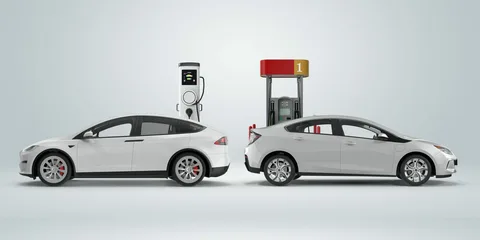
The automobile industry is changing rapidly, and drivers now have more choices than ever when it comes to alternative powertrains.
For decades, petrol and diesel engines dominated the market. Today, hybrid and electric vehicles are becoming increasingly popular as manufacturers work toward reducing fuel consumption and emissions.
But which option is better?
A hybrid car and a fully electric vehicle can both reduce dependence on traditional fuel, but they work in very different ways.
Understanding the differences can help you decide which type of vehicle fits your driving habits, budget, and access to charging infrastructure.
What Is a Hybrid Car?
A hybrid car combines an internal-combustion engine with an electric motor and battery.
Depending on the type of hybrid, the vehicle can use the petrol engine, electric motor, or both.
The battery is usually charged through regenerative braking and the vehicle’s engine. Plug-in hybrids can also be connected to an external charger.
One major advantage of a hybrid is that you do not necessarily need charging infrastructure to use the vehicle.
What Is an Electric Car?
An electric vehicle, or EV, uses electric motors powered by a rechargeable battery.
Unlike a conventional hybrid, a fully electric vehicle does not have a petrol engine providing propulsion.
The battery must be recharged using a suitable charging source.
Electric vehicles are available in different sizes, from small city cars to large SUVs and performance vehicles.
Hybrid vs Electric: The Main Difference
The biggest difference is the power source.
A hybrid combines fuel and electricity.
An EV relies entirely on electricity.
This creates different advantages and disadvantages.
| Feature | Hybrid | Electric |
|---|---|---|
| Petrol engine | Yes | No |
| Electric motor | Yes | Yes |
| Fuel required | Usually | No |
| Charging required | Not always | Yes |
| Tailpipe emissions | Yes | None while driving |
| Refueling | Petrol station | Charging station/home charger |
| Long-distance flexibility | High | Depends on charging network |
Fuel Economy
Hybrids can significantly reduce fuel consumption compared with conventional petrol vehicles, particularly in stop-and-go driving.
The electric motor can assist the engine and recover energy during braking.
Fully electric vehicles can eliminate petrol consumption entirely.
However, the cost of electricity and the efficiency of the vehicle determine how much money you actually save.
Driving Range
Range is one of the major differences between hybrids and EVs.
A conventional hybrid can generally be refueled at a petrol station, meaning long-distance travel does not depend on charging infrastructure.
An EV’s range depends on its battery capacity and efficiency.
Once the battery becomes low, the vehicle needs to be charged.
For people who regularly travel through areas with limited charging infrastructure, this can be an important consideration.
Charging Infrastructure
Charging access is a critical factor when considering an EV.
If you can install a charger at home, owning an electric vehicle can be convenient.
You can charge while the vehicle is parked.
Public charging networks can also provide additional options for longer journeys.
However, charging infrastructure varies significantly between countries and cities.
Hybrid Cars in Nigeria
Hybrid vehicles can be particularly interesting in markets where charging infrastructure is still developing.
Because the petrol engine can continue powering the vehicle, drivers are less dependent on public EV charging stations.
A hybrid can therefore offer some benefits of electrification without completely changing how drivers refuel.
However, buyers should consider the availability of replacement batteries, specialized technicians, and parts.
Electric Cars in Nigeria
Electric vehicles are gradually gaining attention in Nigeria.
However, buyers need to consider local conditions carefully.
Before purchasing an EV, ask:
- Can I charge at home?
- Is electricity reliable enough for my needs?
- Are public chargers available on my regular routes?
- Are qualified EV technicians available?
- Can I obtain replacement parts?
- What happens if the battery develops a problem?
These questions can be more important than the vehicle’s advertised range.
Maintenance
Hybrid and electric vehicles generally have fewer conventional engine components than traditional petrol cars, but they still require maintenance.
Hybrid vehicles contain both combustion and electric systems, which means they have components from both worlds.
EVs do not require traditional engine-oil changes because they do not have combustion engines.
However, EV owners still need to maintain tires, brakes, suspension, cooling systems, and electrical components.
Battery Life
Both hybrids and EVs use batteries, but the battery systems differ.
Hybrid batteries are generally smaller than the batteries used in fully electric vehicles.
EV battery packs are much larger and represent a significant portion of the vehicle’s value.
Modern battery systems are designed to last for many years, but battery health can decline over time.
When buying a used EV or hybrid, battery condition should therefore be part of the inspection process.
Performance
Electric motors provide immediate torque, which can make EVs feel very responsive.
Many electric vehicles can accelerate rapidly from a standstill.
Hybrid vehicles can also provide strong acceleration when the electric motor and combustion engine work together.
Performance depends heavily on the specific model.
Environmental Impact
Fully electric vehicles produce no tailpipe emissions while driving.
However, their overall environmental impact also depends on battery production and how electricity is generated.
Hybrid vehicles still burn fuel and therefore produce exhaust emissions.
Nevertheless, their improved fuel efficiency can reduce fuel consumption compared with comparable conventional vehicles.
Purchase Price
Electric vehicles and hybrids can cost more than comparable conventional vehicles, although this varies considerably by market and model.
The higher initial price may be offset over time by lower fuel or energy costs and, in some cases, lower maintenance requirements.
Buyers should calculate total ownership costs rather than looking only at the purchase price.
Which Is Better for City Driving?
For frequent city driving, both hybrids and EVs can work well.
Hybrid vehicles benefit from regenerative braking and electric assistance during stop-and-go traffic.
EVs can be particularly efficient in urban environments because electric motors can recover energy during deceleration and do not need to idle.
If home charging is convenient, an EV can be an excellent city vehicle.
Which Is Better for Long Trips?
For long-distance travel, a hybrid can provide greater flexibility because it can be refueled quickly at conventional petrol stations.
An EV can also be excellent for road trips when a reliable fast-charging network is available.
The choice therefore depends heavily on your route and charging access.
Hybrid vs EV for First-Time Buyers
If you are purchasing your first electrified vehicle, a hybrid can be an easier transition.
You can continue using petrol stations while becoming familiar with electric driving.
An EV provides a more complete move away from combustion fuel but requires greater attention to charging.
Should You Buy a Hybrid or EV?
Choose a hybrid if:
- You frequently travel long distances.
- Charging infrastructure is limited.
- You want better fuel economy without changing refueling habits.
- You are not ready to depend entirely on charging.
Choose an EV if:
- You have reliable charging access.
- Most of your driving is predictable.
- You want to eliminate petrol use.
- You prefer quiet electric driving.
- You are comfortable planning longer journeys around charging.
Final Thoughts
There is no universal winner between hybrid and electric cars.
A hybrid offers a useful combination of petrol and electric power, making it flexible for long-distance travel and areas where charging infrastructure is limited.
An EV provides a completely electric driving experience and can be highly convenient for drivers who have reliable access to charging.
For Nigerian buyers, charging availability, electricity reliability, maintenance support, and spare-parts availability should be carefully considered.
The best vehicle is not necessarily the one with the newest technology. It is the one that fits your daily routine, budget, infrastructure, and driving needs.
Leave a Reply