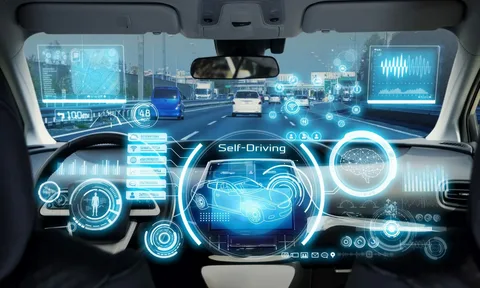
The idea of a car driving itself once belonged mostly to science fiction.
Today, autonomous-driving technology is being actively developed and deployed in different forms. Modern vehicles can already perform tasks such as maintaining speed, staying within lanes, braking automatically, parking, and monitoring surrounding traffic.
However, there is a major difference between driver assistance and a completely autonomous vehicle.
Understanding how autonomous cars work requires looking at the sensors, artificial intelligence, software, maps, computers, and safety systems working together.
What Is an Autonomous Car?
An autonomous car is a vehicle capable of performing some or all driving tasks using automated systems.
The level of automation can vary.
Some vehicles only assist the driver, while more advanced systems can handle driving in specific conditions.
Fully autonomous driving would mean a vehicle could operate without a human needing to control the vehicle under the conditions for which it is designed.
That remains a major technological challenge.
The Levels of Driving Automation
Automotive engineers commonly describe driving automation using levels ranging from Level 0 to Level 5.
Level 0
The driver performs the driving task.
The vehicle may provide warnings or limited automated intervention.
Level 1
The vehicle can assist with one aspect of driving, such as steering or acceleration.
The driver remains responsible.
Level 2
The vehicle can simultaneously assist with steering and speed control under appropriate conditions.
The driver must remain attentive and responsible for driving.
Level 3
The vehicle can perform the driving task under specific conditions, but the human driver may need to take control when requested.
Level 4
The vehicle can operate autonomously within defined conditions or areas.
Level 5
The vehicle would be capable of driving autonomously in essentially all conditions where a human could drive.
Level 5 remains a highly ambitious goal.
Cameras
Cameras are among the most important sensors used by modern driver-assistance systems.
They can identify visual information such as:
- Lane markings
- Traffic signs
- Traffic lights
- Vehicles
- Pedestrians
- Cyclists
- Road obstacles
Computer-vision algorithms process camera images and attempt to understand what is happening around the vehicle.
Radar
Radar uses radio waves to detect objects and estimate their distance and movement.
It can be particularly useful for identifying vehicles ahead and measuring their relative speed.
Radar can complement cameras because each technology has different strengths.
LiDAR
LiDAR uses laser pulses to measure distances and create detailed information about the surrounding environment.
Some autonomous-driving systems use LiDAR because it can provide highly detailed three-dimensional information.
However, LiDAR can increase system cost and requires careful engineering.
Different companies use different combinations of sensors.
Ultrasonic Sensors
Ultrasonic sensors are often used for close-range detection.
They can be useful for parking and detecting nearby objects.
Although their range is limited compared with some other sensors, they can provide valuable information at low speeds.
Artificial Intelligence
Sensors alone do not make a vehicle autonomous.
The vehicle needs software capable of interpreting sensor data.
Artificial intelligence and machine-learning systems can help identify objects, understand road scenes, predict movement, and make driving decisions.
For example, the system may identify a pedestrian near the road and estimate whether that person could enter the vehicle’s path.
Sensor Fusion
One of the key concepts in autonomous driving is sensor fusion.
Instead of relying on one sensor, the vehicle can combine information from multiple sources.
For example, a camera may identify a vehicle while radar measures its distance and speed.
Combining the information can provide a more complete understanding of the environment.
Mapping and GPS
Maps can provide information about roads, intersections, speed limits, and other geographic features.
GPS can help determine the vehicle’s general location.
However, GPS alone is not accurate or reliable enough to handle every driving decision.
Autonomous vehicles need onboard sensors to understand their immediate environment.
Decision Making
Once the vehicle understands its surroundings, it needs to decide what to do.
The system may need to determine whether to:
- Accelerate
- Brake
- Change lanes
- Turn
- Stop
- Yield
- Avoid an obstacle
These decisions must happen quickly.
Predicting Other Road Users
Driving involves more than identifying objects.
A vehicle also needs to predict how those objects might behave.
For example, if a pedestrian is standing near a crossing, an autonomous system may need to estimate whether the person intends to cross.
Similarly, the vehicle may need to predict whether another driver is likely to change lanes.
This is one of the most difficult parts of autonomous driving because human behavior can be unpredictable.
Why Autonomous Driving Is Difficult
Road environments are extremely complicated.
A vehicle may encounter:
- Heavy rain
- Fog
- Poor road markings
- Construction zones
- Animals
- Pedestrians
- Motorcycles
- Unexpected obstacles
- Aggressive drivers
- Damaged roads
A system must be able to respond safely even when conditions differ from those encountered during development and testing.
Autonomous Cars and Safety
Safety is the central challenge of autonomous driving.
A system must not only work correctly in normal conditions but also handle unusual situations.
Manufacturers use extensive testing, simulation, sensor validation, and software development to improve reliability.
Driver-assistance systems are also designed with different limitations depending on their intended operating conditions.
Drivers must understand what their vehicle can and cannot do.
Can Autonomous Cars Drive Without Internet?
An autonomous vehicle does not necessarily need a constant internet connection to perform every driving task.
Much of the processing can happen directly inside the vehicle.
However, connected services can provide useful information such as traffic updates, map updates, software updates, and cloud-based services.
Autonomous Cars and Cybersecurity
Connected vehicles create cybersecurity challenges.
A modern autonomous vehicle contains many computers and communication systems.
Protecting these systems from unauthorized access is essential.
Manufacturers need to secure software, communication channels, updates, and vehicle networks.
Autonomous Cars and Nigerian Roads
Autonomous driving faces additional challenges in environments where road conditions and traffic behavior vary significantly.
Nigerian roads can include a mixture of cars, buses, motorcycles, pedestrians, informal parking, potholes, changing lane patterns, and other unpredictable situations.
For autonomous vehicles to operate reliably in such environments, systems would need to handle local road conditions rather than relying only on data from highly structured roads elsewhere.
Benefits of Autonomous Driving
If developed successfully, autonomous vehicles could provide several potential benefits.
These may include:
- Reduced driver workload
- Improved mobility for some people
- More efficient traffic flow
- Fewer crashes caused by certain human errors
- Improved transportation access
- Better fleet efficiency
However, these benefits depend on the technology becoming sufficiently reliable and being deployed appropriately.
Will Autonomous Cars Replace Drivers?
Probably not immediately.
Automation will likely continue developing gradually.
Some driving tasks may become increasingly automated while humans remain responsible for others.
The transition will depend on technology, regulation, infrastructure, public acceptance, insurance, and safety performance.
Autonomous Cars vs Driver-Assistance Systems
This distinction is extremely important.
A car with adaptive cruise control and lane assistance is not necessarily a self-driving car.
Driver-assistance systems are designed to support the human driver.
An autonomous system is designed to take greater responsibility for the driving task within defined conditions.
Consumers should therefore avoid assuming that advanced marketing language means a vehicle is fully autonomous.
The Future of Autonomous Vehicles
The future may involve several forms of automated transportation.
Robotaxis could operate in carefully mapped urban areas.
Autonomous trucks could potentially travel on major highways.
Delivery vehicles could operate without traditional drivers in controlled environments.
Private cars may gradually receive more advanced automation features.
The technology is likely to develop incrementally rather than arriving as a single dramatic replacement for human driving.
Final Thoughts
Autonomous vehicles combine cameras, radar, LiDAR, GPS, maps, artificial intelligence, powerful computers, and sophisticated software to understand roads and make driving decisions.
The technology has already produced useful driver-assistance features, but fully autonomous driving remains considerably more difficult.
The biggest challenge is not simply making a car move without human input. It is making the vehicle behave safely and reliably when the road presents unexpected situations.
As artificial intelligence and sensor technology improve, autonomous vehicles will likely become increasingly capable.
However, safety, regulation, cybersecurity, infrastructure, and public trust will determine how quickly they become part of everyday transportation.
The future of driving may be increasingly automated, but the road from today’s driver assistance to truly autonomous transportation is still being built one software update at a time.
Leave a Reply