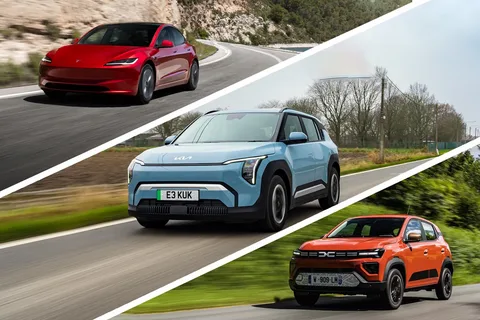
Electric cars have moved from being a niche alternative to becoming an important part of the global automobile industry. As battery technology improves and manufacturers introduce more models, drivers have more choices than ever.
Today’s electric vehicles are available in different sizes and price categories. Buyers can choose compact city cars, family sedans, crossovers, SUVs, luxury vehicles, and high-performance models.
But choosing an electric car requires looking beyond the badge. Range, charging speed, battery technology, efficiency, software, service support, and charging infrastructure all matter.
What Is an Electric Car?
An electric car uses one or more electric motors powered by a rechargeable battery.
Unlike conventional petrol vehicles, a fully electric car does not use an internal-combustion engine to propel the vehicle.
Electric motors can deliver torque almost immediately, giving EVs a responsive driving experience.
1. Tesla Model 3
The Tesla Model 3 remains one of the most recognizable electric sedans.
It combines a relatively compact body with strong performance, useful range, modern software, and access to Tesla’s charging ecosystem in supported markets.
The exact range and performance depend on the specific version.
2. Hyundai Ioniq 6
The Hyundai Ioniq 6 uses a streamlined design intended to improve aerodynamic efficiency.
Its low-slung shape gives it a distinctive appearance compared with conventional sedans.
The vehicle also benefits from Hyundai’s dedicated electric platform and fast-charging technology.
3. BMW i4
The BMW i4 combines electric propulsion with the driving characteristics associated with BMW’s sportier sedans.
It offers a premium interior and multiple performance configurations depending on the market.
For buyers who want an EV without giving up a more traditional luxury-sedan experience, the i4 can be an attractive option.
4. Tesla Model S
The Model S sits at the premium end of Tesla’s sedan lineup.
It offers high performance, long-distance capability, and extensive technology.
It is aimed at buyers who want an electric vehicle with performance approaching high-end luxury cars.
5. Porsche Taycan
The Porsche Taycan demonstrates how electric power can be combined with sports-car performance.
It provides rapid acceleration, sophisticated chassis technology, and a premium interior.
The Taycan is not designed primarily as a budget-friendly EV, but it shows the performance potential of electric motors.
6. Lucid Air
The Lucid Air is a premium electric sedan that places considerable emphasis on range and efficiency.
Its aerodynamic design and large battery options help it compete in the luxury EV market.
It is particularly interesting for buyers who prioritize long-distance electric driving.
Electric Car Range
Range is one of the most important specifications for EV shoppers.
However, the official range figure should not be treated as a guarantee.
Real-world range can change depending on:
- Driving speed
- Temperature
- Terrain
- Air conditioning
- Tire pressure
- Traffic
- Driving style
- Vehicle load
Highway driving at high speeds can consume more energy than slower urban driving.
Charging Speed
Charging speed can determine how convenient an EV is for long-distance travel.
Some vehicles can accept high-power DC fast charging, allowing a significant amount of energy to be added during a relatively short stop.
However, charging speed depends on the vehicle, charger, battery temperature, state of charge, and charging infrastructure.
Home Charging
Home charging is one of the biggest advantages of EV ownership.
Instead of visiting a petrol station regularly, owners can charge their vehicles while they are parked.
A suitable home charging installation can make daily EV ownership much easier.
Electric Cars in Nigeria
Nigerian buyers need to consider charging infrastructure carefully.
Before purchasing an EV, investigate whether you can reliably charge the vehicle at home or at locations along your regular routes.
Other considerations include:
- Electricity availability
- Charging equipment
- Vehicle servicing
- Spare parts
- Battery support
- Technician availability
- Warranty coverage
The best electric car on paper may not be the best choice if it is difficult to charge or maintain locally.
Battery Technology
The battery is one of the most important components in an EV.
Battery chemistry affects energy density, charging behavior, longevity, cost, and performance.
Manufacturers continue to develop improved battery technologies that could eventually increase range while reducing weight and cost.
Electric Car Maintenance
EVs generally have fewer moving drivetrain components than petrol vehicles.
There is no conventional engine oil or exhaust system to maintain.
However, EVs still require maintenance for:
- Tires
- Brakes
- Suspension
- Steering
- Cooling systems
- Battery systems
- Electrical components
Battery health is especially important when buying a used EV.
Performance
Electric vehicles can deliver impressive acceleration because electric motors provide immediate torque.
Even family-oriented EVs can feel quick.
Performance-focused models can accelerate extremely rapidly.
However, aggressive driving can reduce efficiency and therefore decrease driving range.
Final Thoughts
Electric cars in 2026 offer an increasingly wide range of choices.
Models such as the Tesla Model 3, Hyundai Ioniq 6, BMW i4, Porsche Taycan, Tesla Model S, and Lucid Air demonstrate how varied the EV market has become.
When choosing an electric vehicle, consider more than range.
Charging access, battery warranty, efficiency, maintenance, software, service availability, and local infrastructure can have a major impact on ownership.
For Nigerian buyers in particular, charging and after-sales support should be among the first things investigated.
As battery technology and charging infrastructure continue to improve, electric cars are likely to become an increasingly important part of the global automotive landscape.
Leave a Reply