The automobile has traditionally depended on one essential component: the human driver.
The driver observes the road, interprets traffic conditions, controls the steering wheel, accelerates, brakes, and makes decisions.
New technologies are beginning to change that relationship.
Modern vehicles can now perform some driving tasks automatically, while autonomous-driving companies are developing systems capable of handling increasingly complex environments.
But how different are self-driving vehicles from traditional cars?
What Is a Traditional Car?
A traditional car requires a human driver to control the vehicle.
Modern traditional cars can still include electronic assistance systems, but the driver remains responsible for driving.
Features such as automatic emergency braking and adaptive cruise control can provide assistance without making the vehicle fully autonomous.
What Is a Self-Driving Car?
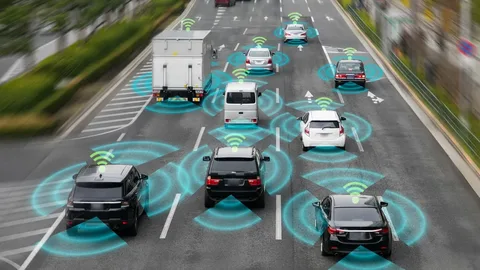
A self-driving vehicle uses sensors, software, artificial intelligence, and onboard computers to perform some or all driving tasks.
The level of automation depends on the system.
Some technologies can only assist with steering and speed, while more advanced systems can operate autonomously under specific conditions.
Sensors
Self-driving vehicles can use multiple types of sensors.
These may include:
- Cameras
- Radar
- LiDAR
- Ultrasonic sensors
- GPS
- Inertial sensors
Each sensor provides different information about the environment.
Artificial Intelligence
AI is essential to autonomous driving.
The software needs to identify objects, understand road conditions, predict movements, and select appropriate actions.
For example, the system may recognize a pedestrian approaching a road crossing and determine whether braking may be necessary.
Human Drivers vs AI
Humans have the ability to interpret complicated social situations and unexpected road behavior.
AI systems, however, can process sensor information extremely quickly and do not become tired or distracted in the same way humans can.
The challenge is making AI reliable enough to handle the enormous variety of real-world situations.
Safety
Safety is one of the biggest arguments surrounding autonomous driving.
Human error contributes to many road accidents, including accidents involving distraction, fatigue, speeding, and poor judgment.
Automation could potentially reduce some categories of human error.
However, autonomous systems can also make mistakes.
Therefore, the technology must be carefully tested and designed with appropriate safety mechanisms.
Traffic Efficiency
Connected and autonomous vehicles could potentially improve traffic flow.
Vehicles may communicate with traffic systems and adjust speed more efficiently.
Automated driving could also reduce unnecessary acceleration and braking.
However, achieving these benefits would require widespread adoption and coordination.
Parking
Automated parking is already available in some vehicles.
The system can identify a suitable parking space and control steering, acceleration, and braking during the maneuver.
Future autonomous vehicles may be able to handle much more complex parking environments.
Accessibility
Autonomous transportation could provide greater mobility for people who cannot drive themselves.
Older adults and people with certain disabilities could potentially benefit from automated transportation.
However, accessibility benefits will depend on affordability and availability.
Self-Driving Cars and Nigerian Roads
Autonomous vehicles face unique challenges in Nigeria.
Traffic conditions can be unpredictable, and roads can contain potholes, motorcycles, pedestrians, commercial buses, informal parking, and changing lane patterns.
A self-driving system developed primarily for highly structured road environments may require additional development before operating reliably in more complex environments.
Cost
Advanced sensors and computing systems can increase vehicle costs.
As the technology becomes more common, manufacturing scale and technological improvements could potentially reduce costs.
However, premium autonomous systems may remain expensive for some time.
Cybersecurity
Connected vehicles require strong cybersecurity.
A self-driving car is essentially a sophisticated computer system with wheels.
Protecting its software and communication systems is therefore critical.
Manufacturers need to defend vehicles against unauthorized access and malicious software.
Traditional Cars Are Not Disappearing Immediately
Even as autonomous technology develops, traditional vehicles will remain on roads for many years.
The global vehicle fleet is enormous, and replacing it takes time.
Many future vehicles will probably combine traditional controls with increasingly advanced automated assistance.
Will Steering Wheels Disappear?
Not necessarily.
Some vehicles designed for specific autonomous services may eventually operate without conventional controls.
However, privately owned vehicles may continue to include steering wheels and pedals for a long time, especially where regulations require human control.
The Future of Driving
The automotive industry is gradually moving from mechanical assistance toward software-driven transportation.
Future cars may communicate with roads, other vehicles, cloud systems, and traffic infrastructure.
Drivers may increasingly supervise automated systems rather than manually control every part of a journey.
Final Thoughts
Self-driving technology could fundamentally change transportation, but the transition will not happen overnight.
Traditional cars remain the dominant form of transportation, while autonomous technology is developing through increasingly advanced driver-assistance and automated-driving systems.
The biggest challenges include safety, cybersecurity, regulation, infrastructure, cost, and the ability to handle unpredictable real-world environments.
For countries such as Nigeria, local road conditions will be particularly important.
The future may not be a simple battle between human drivers and computers. Instead, the automotive industry is likely to spend years developing a middle ground where humans and intelligent systems share responsibility for getting people safely from one place to another.
Leave a Reply